
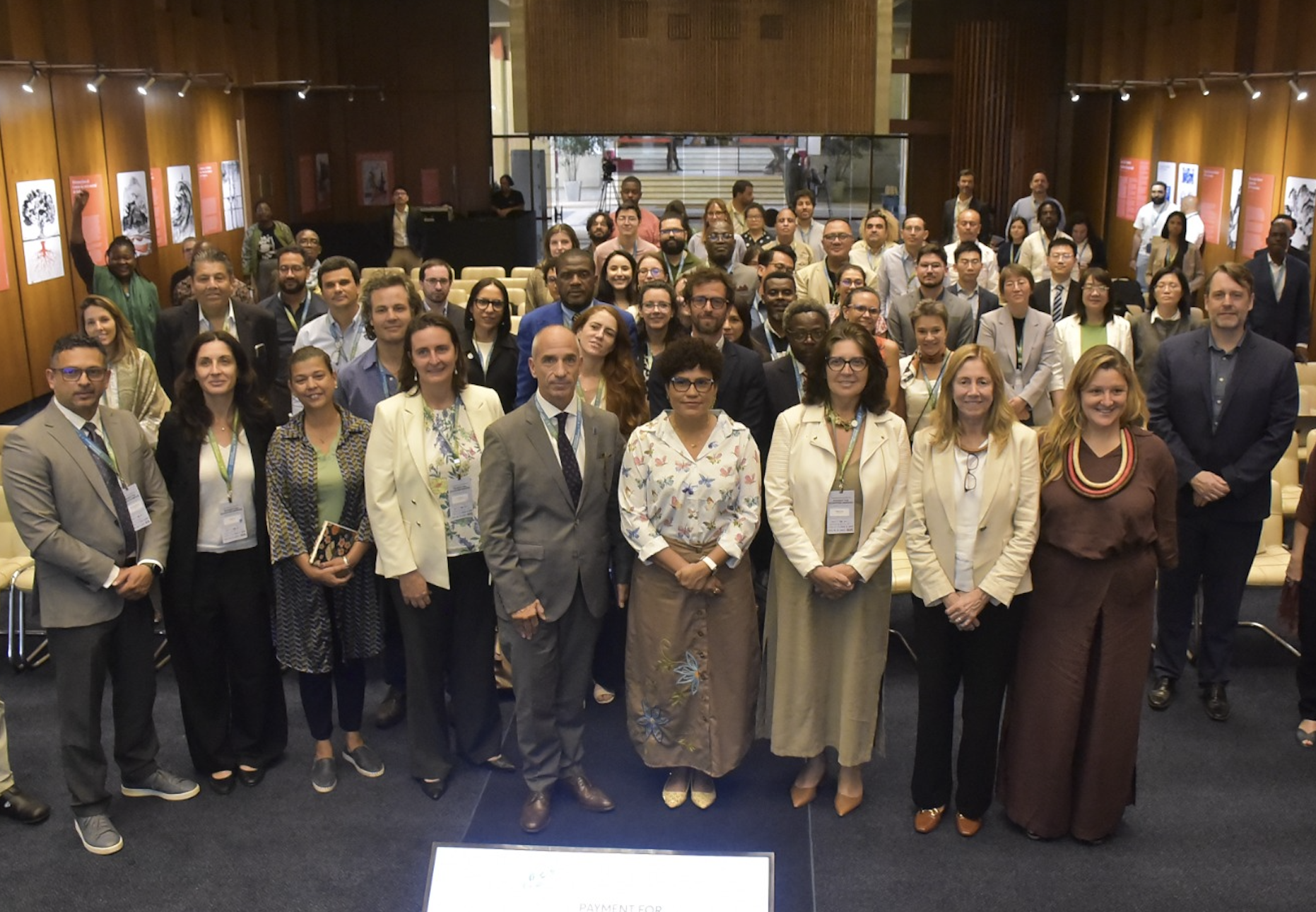
The 1st International Dialogue on Payment for Environmental Services (PES)—led by the Government of Brazil—launches a structured, long-term exchange process focused, in this first edition, on PES financing mechanisms.
A turning point: from one-off exchanges to a structured long-term process
For years, leaders and technical teams working on Payment for Environmental Services (PES) have built strong national experience—yet many have shared the same frustration: international exchanges have often remained bilateral, isolated, or short-lived, without a sustained platform for continuity, follow-up, and long-term impact.
This week, that gap begins to close. Nineteen countries from Asia, Africa, and Latin America and the Caribbean are participating in the 1st International Dialogue on Payment for Environmental Services (PES), taking place in Brasília, Brazil (19–21 May 2026). This dialogue inaugurates a series of international, technical-operational dialogues designed as a peer-to-peer, implementation-oriented platform.
Why financing—and why now
This first Dialogue focuses on a central constraint faced by many PES efforts: financing. While countries have made significant progress in structuring and monitoring the supply of environmental services, a persistent gap remains on the demand side, and therefore in the sustainable financing required to scale PES systems over time.
The timing of this Dialogue is not accidental. It builds on renewed global momentum around forest finance and nature-based solutions, strongly reinforced by Brazil’s leadership in the lead-up to COP30. Recent developments—such as the launch of the Tropical Forest Forever Facility (TFFF)—have helped galvanize political attention and created a sense of urgency among governments to move from discussion to implementation and scaling of financing solutions for forests and environmental services.
Within this context, the International Dialogue responds directly to countries’ demand to sustain this momentum through a more structured, technical, and forward-looking exchange platform.
The broader International Dialogues process is structured around four core challenges for effective and scalable PES programmes—starting with scaling and financing (public, private and hybrid sources), followed by governance structures of PES programmes, metrics and digital platforms, and engagement with local communities.
UNDP’s role so far: Practical experience, technical integration, and climate finance linkage
UNDP’s engagement in PES is grounded in long-standing country support work and practical implementation support.
UNDP has supported PES financing pathways by:
- Helping countries mobilize climate finance and results-based finance, including access and mobilization efforts linked to major mechanisms such as the Green Climate Fund (GCF) in Brazil (Floresta+), Costa Rica and Ecuador (ProAmazonia).
- Supporting the transformation of PES concepts into implementable public policy instruments, including institutional coordination, monitoring arrangements, delivery mechanisms, and digital systems—so countries can move from isolated pilots to scalable and credible PES systems.
Facilitating targeted country participation and cross-regional connection as part of UNDP’s role as a neutral platform and South–South cooperation facilitator for this process.
UNDP’s role going forward: ensuring continuity and enabling the next generation of PES financing systems
The Brasília Dialogue is positioned not as a stand-alone event, but as the first step in a broader cooperation architecture—including the establishment of a Community of Practice, identification of country demands, and sustained follow-up through shared outputs and roadmaps.
Going forward, UNDP’s contribution is expected to focus on three complementary functions already articulated in the Dialogue documentation:
- Continue supporting countries to mobilize climate finance and results-based finance through voluntary carbon markets, GCF, and bilateral cooperation such as the Germany’s International Climate Initiative of Germany, which is funding ForestFlow in Mesoamerica currently being developed by UNDP.
- A facilitator of South–South cooperation, helping link this Dialogue to broader pipelines of cooperation on PES, forest finance, and results-based climate finance.
A trusted partner for the multi-dialogue process, supporting the sequence of exchanges planned across regions, including the upcoming Dialogue in Costa Rica (October 2026), coordinated by the Costa Rican Authorities.
This ambition is fully aligned with the direction of UNDP’s strategic approach, which calls for integrated, country-driven solutions that advance human development on a healthy planet. For UNDP, PES is precisely the kind of agenda where governance, sustainable finance, digital solutions, gender equality, indigenous people and local communities need to come together.
By Noelia Jover - Senior Regional Technical Advisor (LAC) and Lapo Sermonti - Specialist on Payments for Environmental Services